
Welcome back to another edition of The Maine Question, the newsletter about DTA v. Schneider, the Maine ballot initiative-turned-lawsuit that could finally rein in SuperPACs.
In our last post, we made one point very clear: as intervenors, we are not advocating to overturn the Supreme Court’s 2010 decision in Citizens United v. FEC. (TL;DR Citizens United was a decision that removed limits on how much independent expenditure committees — i.e., SuperPACs — could spend in elections.)
Instead, we are asking a new question — one that the Supreme Court has not addressed:
Is it constitutional to place limits on how much money a person or entity can contribute to a SuperPAC annually?
In November 2024, Maine voters attempted to set that limit at $5,000. The constitutionality of this limit is being determined in the courts.
(To learn more about our argument for why SuperPAC contribution limits are constitutional, check out our last article.)
But why five thousand dollars?
Why not $5,001, $4,999, or higher? In this article, we will explain how the architects of Maine’s 2024 Question 1 landed on this magic number.
What’s so important about the number five thousand?
To answer this question, Equal Citizens retained the help of Christopher Robertson, a preeminent social scientist and professor at Boston University School of Law.
Robertson carried out two survey experiments. One tested the perceptions of campaign contribution limits and corruption, and the other measured the effects of Maine’s $5k SuperPAC contribution limit.
To carry out his experiments, Robertson surveyed a demographically representative sample of over 1,100 American citizens — none of whom were lawyers.
Here are his two main conclusions:
The larger the financial contribution to a committee, the more likely the public perceives quid pro quo (“this-for-that”) corruption.
A $5k contribution cap increases confidence in democratic legitimacy and the effectiveness of the American government to serve the public interest.
Experiment One
The first of Robertson’s survey experiments was designed to measure the relationship between contribution size and the perceived risk of quid pro quo corruption. He asked the following question, where X ranged from $5 to $50 million on a logarithmic scale.
“Please think about the risk that a politician would sell a policy outcome, like a vote on a bill, in exchange for a financial contribution to a committee supporting his or her re-election. Doing so violates his or her oath and creates a risk of prosecution, if discovered. Suppose the contribution was $X.”
Each participant was randomly assigned a contribution size of X ($5, $50, $5,000, $50,000, $500,000, $5,000,000, or $50,000,000), with an equal number of respondents being assigned to each dollar amount. The survey indicated their perception of corruption on a scale of “extremely likely” to “extremely unlikely.”
Below is a graph of what Robertson found:
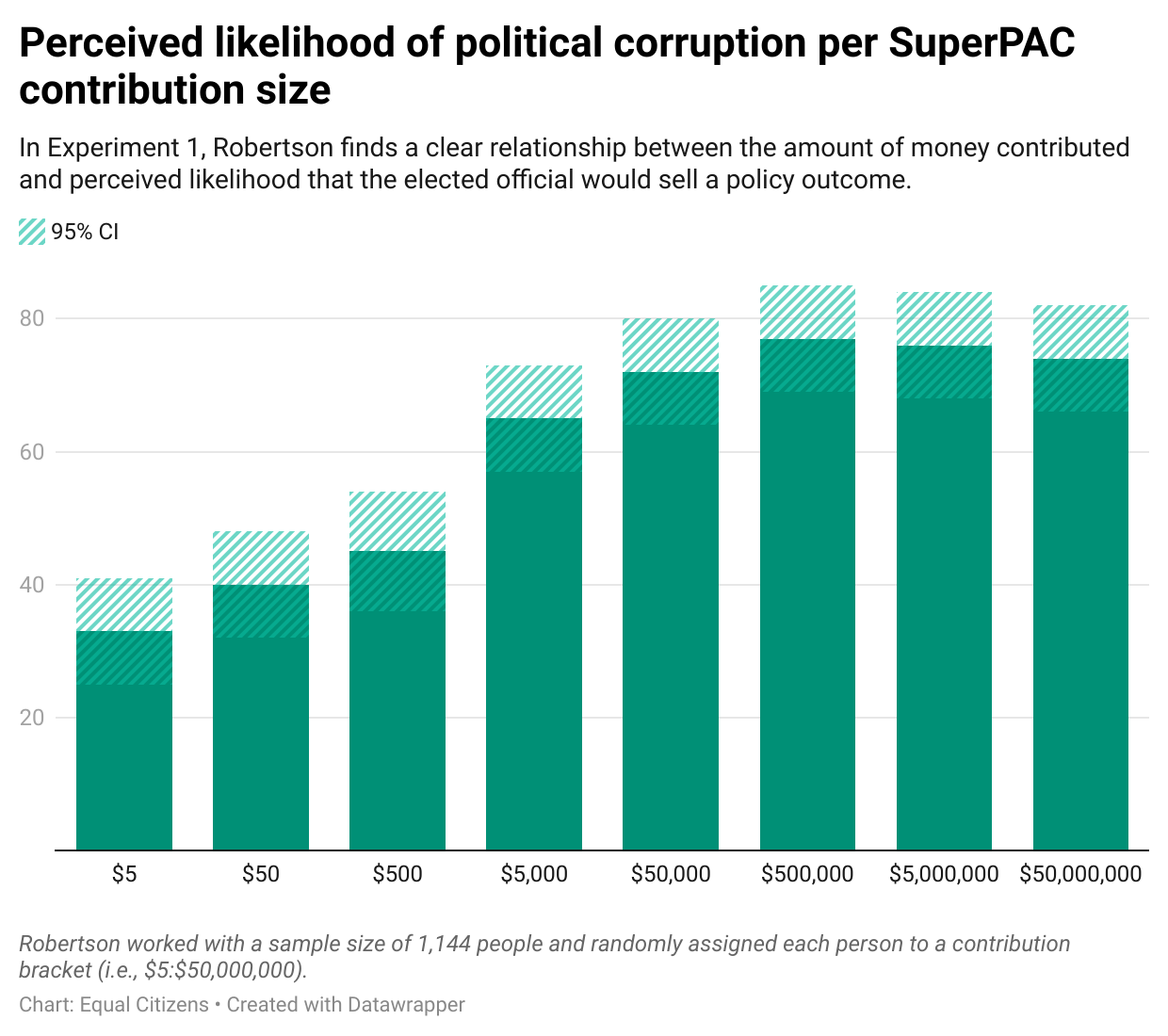
Let’s break it down.
First, fewer than half of the respondents linked contributions of $500 or less to quid pro quo corruption. That makes sense! A few small donations are very unlikely to affect how politicians act, and Americans get that. But once contributions hit the $5,000 mark, perceptions begin to change. At $5,000, two-thirds of respondents claimed it is likely a politician will sell a policy outcome in exchange for donations of that size to a SuperPAC.
The final — and critically important — takeaway is that after the $5,000 mark, perceptions of quid pro quo corruption do not meaningfully increase. Yes, slightly more respondents believe that contributions between $50,000 and $50 million will increase the likelihood of corruption, but this difference is not statistically significant. We can conclude that, as far as the public is concerned, contributions to SuperPACs as low as $5,000 undermine faith in our political system.
Experiment Two
Robertson’s second experiment takes this finding one step further and investigates perceptions of state governments that have SuperPAC contribution limits. To do this, Robertson carried out a vignette study — a survey research method that provides survey takers with variants of the same short story or prompt to measure their views on complex social phenomena. (It’s actually very difficult to accurately capture complex social phenomena on surveys! That’s why academics often have to get creative with their research design.)
In this case, Robertson designed a hypothetical state called “Ames” adopting real-world campaign finance laws. The rules for Ames were presented to each participant, making a clear distinction between the laws governing direct vs indirect campaign contributions:
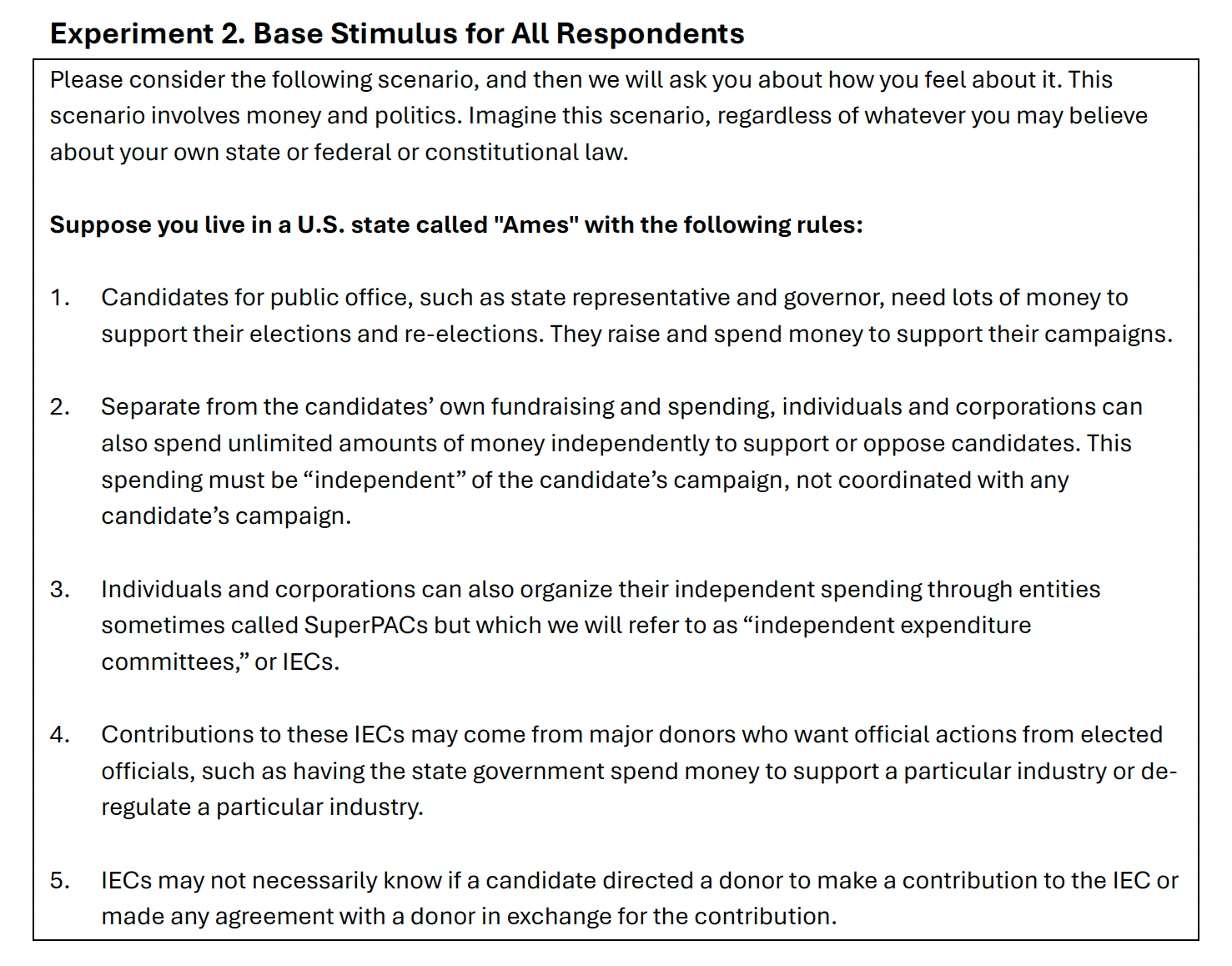
Participants were randomly assigned to one of two theoretical Ames states. The first state has a policy that caps contributions to SuperPACs to $5k (i.e., treatment group), making all contributions above $5k illegal. The second policy models the real world with no caps (i.e., control group).
Then, all participants were asked whether they agree or disagree with various statements about the risk of corruption and governmental efficacy, such as:
“In Ames, people like me are likely to have a strong voice in the government.”
“Elected officials in Ames are likely to provide policy outcomes in exchange for large contributions to the IECs that support them.”
“Major donors to IECs in Ames are likely to get policy outcomes in exchange for their money.”
“Contributions to IECs will likely facilitate political quid pro quos (an exchange of one thing for another) between donors and candidates for public office in Ames.”
Robertson found that a $5k cap on SuperPAC contributions has a “significant and substantial effect on perceptions of quid pro quo corruption and that the cap supports broader perceptions of democratic legitimacy and effectiveness.” In other words, respondents were far more likely to agree to statements like “In Ames, people like me are likely to have a strong voice in government,” if they were placed into the treatment group, or the version of Ames with $5k limits.
Once Again: What’s so important about the number five thousand?
So to answer the original question: Why $5,000? First, we find that a donation of $5,000 to a SuperPAC is the point at which Americans begin to perceive a serious likelihood of quid pro quo corruption. Second, the implementation of a $5,000 contribution limit to SuperPACs significantly reduces perceptions of quid pro quo corruption and increases belief in democratic legitimacy and effectiveness.
These conclusions build off years of additional academic research and reflect what Mainers already know so well to be true: a government beholden to dark money is a government Americans are less likely to trust.
And together we can — and will — restore this trust.
[Written by Maia Cook, Executive Director]